Story Info
Story Info
Harriet Sams
Broomrigg, Cumbria, UK
2023
Type of Wounded Place
Story & Experience
In 2010, a group of Rad Joy participants went to the site, when the plantation was mature, soaring above our heads. We found a terribly degraded, forgotten site, which, for whatever reasons, was being allowed to degrade.
This year, we returned when the site had been cleared, and new Christmas tree saplings had been planted. It was a hot day, with horseflies biting, and midges buzzing around us. The site had suffered recently through the toppling of trees during Storm Desmond, further ripping up the land.
As we shared our emotions, feelings of anger, of confusion, of sorrow and of helplessness arose. A participant expressed they wanted to know more about the site, why it was how it was, how it got to be like it was. One young participant felt frustrated by the many flies. I felt a huge sense of responsibility. Of what, I wasn’t sure.
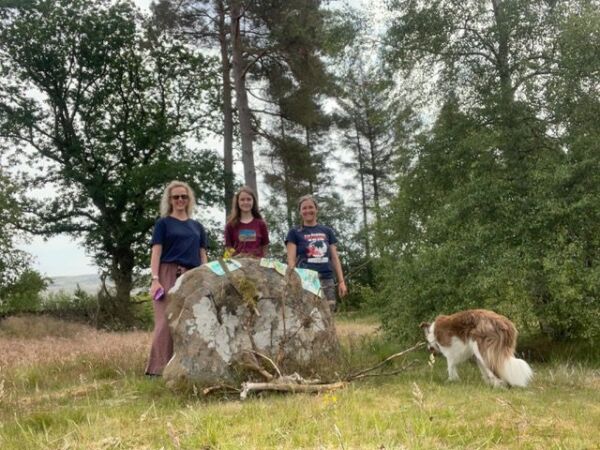
As we explored, we found a circle, mostly covered by bracken and fallen logs. We stood for a while on one of the huge stones, wondering at why our ancestors felt this site to be so significant to them and why in modern times we had so roundly forgotten these ancient stories of land, of sacred space and of belonging to the whole. We noticed how being here felt like we were connecting to the point in time where landscape, animals and ancestors could speak to us, and we them, a time of belonging to the Whole marked out in stone on the land.
As we talked about how we felt now, a calm had descended. Gone were frustrations with the flies, (although they still bit) and a wonder at the complex life of the place, flies, mice, flowers, and larger animals, whose trails we could see. Gone too was the feeling of not knowing enough, replaced by a gladness to be getting to know the site. This is a practice of a process of relationship. Gone, too was the strong feeling of responsibility to ‘fix’, to a realisation that we simply have to be present, and to show the site how it is in our hearts, and our consciousness. This may in turn become stewardship. But the pressure of fixing dissipated.
It was a strong, short and meaningful time, together with the land. Three introverts in a broken landscape! We continued the returning to reverence and love of place, that had began over a decade ago.
In 2010, a group of Rad Joy participants went to the site, when the plantation was mature, soaring above our heads. We found a terribly degraded, forgotten site, which, for whatever reasons, was being allowed to degrade.
This year, we returned when the site had been cleared, and new Christmas tree saplings had been planted. It was a hot day, with horseflies biting, and midges buzzing around us. The site had suffered recently through the toppling of trees during Storm Desmond, further ripping up the land.
As we shared our emotions, feelings of anger, of confusion, of sorrow and of helplessness arose. A participant expressed they wanted to know more about the site, why it was how it was, how it got to be like it was. One young participant felt frustrated by the many flies. I felt a huge sense of responsibility. Of what, I wasn’t sure.
As we explored, we found a circle, mostly covered by bracken and fallen logs. We stood for a while on one of the huge stones, wondering at why our ancestors felt this site to be so significant to them and why in modern times we had so roundly forgotten these ancient stories of land, of sacred space and of belonging to the whole. We noticed how being here felt like we were connecting to the point in time where landscape, animals and ancestors could speak to us, and we them, a time of belonging to the Whole marked out in stone on the land.
As we talked about how we felt now, a calm had descended. Gone were frustrations with the flies, (although they still bit) and a wonder at the complex life of the place, flies, mice, flowers, and larger animals, whose trails we could see. Gone too was the feeling of not knowing enough, replaced by a gladness to be getting to know the site. This is a practice of a process of relationship. Gone, too was the strong feeling of responsibility to ‘fix’, to a realisation that we simply have to be present, and to show the site how it is in our hearts, and our consciousness. This may in turn become stewardship. But the pressure of fixing dissipated.
It was a strong, short and meaningful time, together with the land. Three introverts in a broken landscape! We continued the returning to reverence and love of place, that had began over a decade ago.
Why this Place?
Broomrigg, Cumbria, UK
Broomrigg is a Neolithic and Bronze Age multiphase stone complex, which includes three stone circles, a stone avenue and satellite burials. It has been a tree plantation since the 19th century, which has meant that successive generations of planted trees and the subsequent deforestation has caused significant damage to the stones, as well as to the archaeology beneath the ground.
Act of Beauty
Say more about your actions and activity
We then began to make the Rad Joy bird, out of fallen broken bits of pine tree, of dried oak leaves, of moss and flowers. We made it propped up against the large stone of one of the circles, and it looked like a phoenix with bright golden flowers in its beak.

RECENT STORIES
For the Gulf Coast
Our beaches are being bombarded almost daily since the end of the first week of the sinking of the Deep Water Horizon with gatherings of people or all stripes: protests, prayer groups, volunteers, rallies for [...]
Remembrance Day for Lost Species in Helsinki 2023
On November 30th, there was first a session organized by the Finnish social and health sector project about eco-anxiety and eco-emotions (www.ymparistoahdistus.fi). This “morning coffee roundtable”, a hybrid event, focused this time on ecological grief [...]
Ashdown Forest
Ashdown Forest is an area of natural beauty in West Sussex, England. It is also one of the very few remaining areas of extensive lowland heath left in Europe. This rare and threatened landscape is [...]