Story Info
Story Info
Tom deBree
Confluence Park, Denver, CO
2017
Type of Wounded Place
Story & Experience
Confluence Park will soon be completed in urban Denver, Colorado. The project redirects converging waters of the South Platte River and Cherry Creek at a site which offered, as recently as 1858, a place for early white settlers to encamp, in sight of the Arapaho Tribal village just across the river. Today a scene of urban development surrounds the merging waters. High rise housing, business, and entertainment venues continue to extend and expand along and over the water banks in the heart of downtown Denver.
I sat down, observed and listened. Construction workers shouted signals to each other. Children happily splashed in the water. Vendors hawked fast food on the banks. After a while I drifted up a grassy slope overlooking the confluence. From there I held a wider view of the place, though I felt a bit removed, too.
I felt sad, removed, ashamed and angry with my own species of life, we homo sapiens, for the arrogance, short-sightedness, emotional indifference to place and life beyond the pressing human interests of profit and growth. The original water channels and animal habitations, those living beings Given to the site, were actually moved to align with the human design and development of Confluence Park. And now the work is almost complete. I was here last year with my granddaughters for the 2016 GEx. This year I am alone.
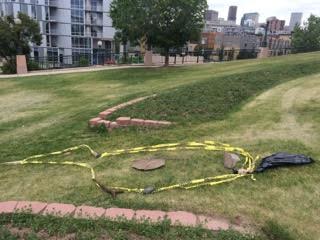
I composed a RadJoy Bird to watch and listen with me. The RadJoy Bird body outline I pulled into place with stray pieces of plastic yellow construction ribbon, a soft barrier warning to alert pedestrians to inherent dangers near construction sites. “CAUTION! CUIDADO!” I gathered a few discarded trash bags to shape her folded wings and her fanning tail, rocks to hold her body intact for a few hours
While I missed the candid hearts and keen eyes of my granddaughters, I was more aware of ambiguity in my feelings and thoughts this year. Sitting at some distance above the waters, I surrendered my mind and heart to the original wild of the river and creek …a wild I could only imagine… when the peace and beauty must have struck human eyes with astonishing simplicity and depth. I could see the waters joined at the very site where colonial settlers searching for gold 159 years ago became new neighbors to Native Americans peoples inhabiting the land. But, except for the sonorous rush of the waters raised from the winter snow melt-off in the Rocky Mountains, the original wild beauty of the place, was all but extinguished, not to forget the possibility of respect for different cultures and peoples. I grieve this absence. Even as I appreciate skilled labor to design an attractive site for urban human activities—recreation, entertainment, markets… I rue our hubris. People splash in the newly fashioned water run currents, no doubt designed with good intent. Yet, is our refreshment and play all we could know in their life?
Construction cranes hang out over the site, and busy hard-hatted workers pour cement. Graded social areas and descending steps access the waters. New dense housing structures rise along the banks. Yet, what was already Given here for thousands and thousands of years seems dismissed. It feels so very cavalier, the indifference to the whole of nature. How much and how far shall we humans assault the earth, air and waters of the original Gift of life to accommodate and invite further human population growth and industry? Our will is presumptively carved into the creek and river banks. I wonder what and how wisdom in the waters might have adjusted the design. The industry is not so much beautiful, as it is fast, sleek and powerful. It is devoid of care and respect for what of the wild we do not understand. So little evidence of restraint, humility, gratitude for what was Given in the first place.
Confluence Park will soon be completed in urban Denver, Colorado. The project redirects converging waters of the South Platte River and Cherry Creek at a site which offered, as recently as 1858, a place for early white settlers to encamp, in sight of the Arapaho Tribal village just across the river. Today a scene of urban development surrounds the merging waters. High rise housing, business, and entertainment venues continue to extend and expand along and over the water banks in the heart of downtown Denver.
I sat down, observed and listened. Construction workers shouted signals to each other. Children happily splashed in the water. Vendors hawked fast food on the banks. After a while I drifted up a grassy slope overlooking the confluence. From there I held a wider view of the place, though I felt a bit removed, too.
I felt sad, removed, ashamed and angry with my own species of life, we homo sapiens, for the arrogance, short-sightedness, emotional indifference to place and life beyond the pressing human interests of profit and growth. The original water channels and animal habitations, those living beings Given to the site, were actually moved to align with the human design and development of Confluence Park. And now the work is almost complete. I was here last year with my granddaughters for the 2016 GEx. This year I am alone.
I composed a RadJoy Bird to watch and listen with me. The RadJoy Bird body outline I pulled into place with stray pieces of plastic yellow construction ribbon, a soft barrier warning to alert pedestrians to inherent dangers near construction sites. “CAUTION! CUIDADO!” I gathered a few discarded trash bags to shape her folded wings and her fanning tail, rocks to hold her body intact for a few hours
While I missed the candid hearts and keen eyes of my granddaughters, I was more aware of ambiguity in my feelings and thoughts this year. Sitting at some distance above the waters, I surrendered my mind and heart to the original wild of the river and creek …a wild I could only imagine… when the peace and beauty must have struck human eyes with astonishing simplicity and depth. I could see the waters joined at the very site where colonial settlers searching for gold 159 years ago became new neighbors to Native Americans peoples inhabiting the land. But, except for the sonorous rush of the waters raised from the winter snow melt-off in the Rocky Mountains, the original wild beauty of the place, was all but extinguished, not to forget the possibility of respect for different cultures and peoples. I grieve this absence. Even as I appreciate skilled labor to design an attractive site for urban human activities—recreation, entertainment, markets… I rue our hubris. People splash in the newly fashioned water run currents, no doubt designed with good intent. Yet, is our refreshment and play all we could know in their life?
Construction cranes hang out over the site, and busy hard-hatted workers pour cement. Graded social areas and descending steps access the waters. New dense housing structures rise along the banks. Yet, what was already Given here for thousands and thousands of years seems dismissed. It feels so very cavalier, the indifference to the whole of nature. How much and how far shall we humans assault the earth, air and waters of the original Gift of life to accommodate and invite further human population growth and industry? Our will is presumptively carved into the creek and river banks. I wonder what and how wisdom in the waters might have adjusted the design. The industry is not so much beautiful, as it is fast, sleek and powerful. It is devoid of care and respect for what of the wild we do not understand. So little evidence of restraint, humility, gratitude for what was Given in the first place.
Confluence Park, Denver, CO
RECENT STORIES
For the Gulf Coast
Our beaches are being bombarded almost daily since the end of the first week of the sinking of the Deep Water Horizon with gatherings of people or all stripes: protests, prayer groups, volunteers, rallies for [...]
Remembrance Day for Lost Species in Helsinki 2023
On November 30th, there was first a session organized by the Finnish social and health sector project about eco-anxiety and eco-emotions (www.ymparistoahdistus.fi). This “morning coffee roundtable”, a hybrid event, focused this time on ecological grief [...]
Ashdown Forest
Ashdown Forest is an area of natural beauty in West Sussex, England. It is also one of the very few remaining areas of extensive lowland heath left in Europe. This rare and threatened landscape is [...]